
Published on March 6, 2026
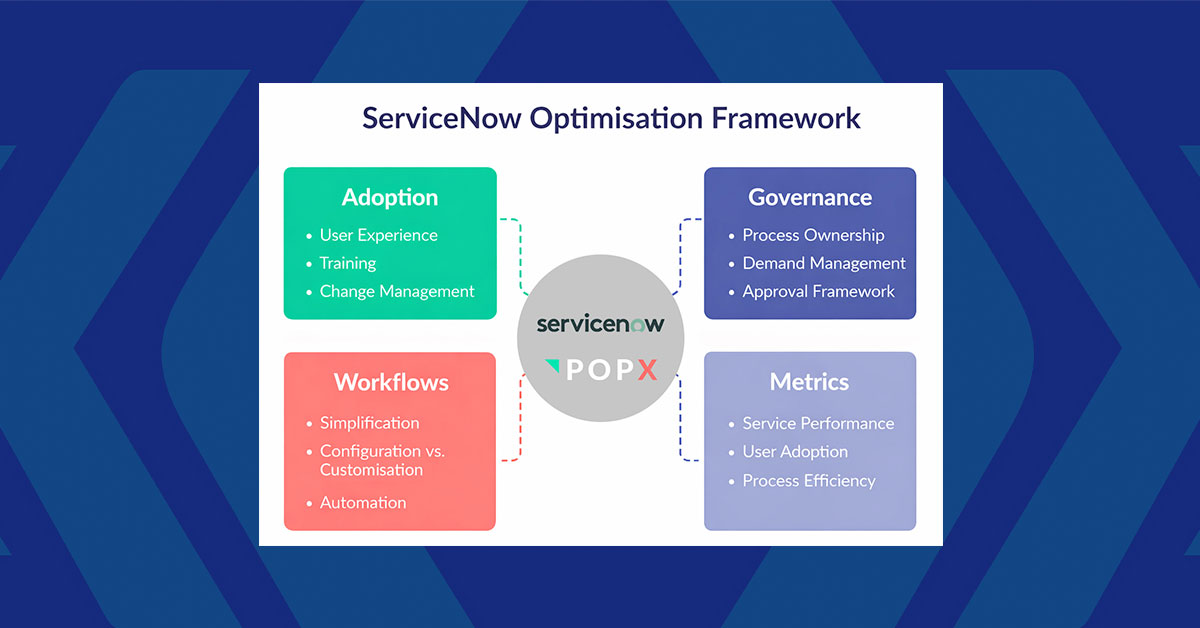
Many organisations invest heavily in ServiceNow expecting it to streamline operations, improve service delivery, and provide a single platform for managing IT and business workflows. But after implementation, many teams find that ServiceNow isn’t delivering the value they expected.
If it feels like ServiceNow isn’t working properly, you’re not alone. Organisations often encounter problems such as low user adoption, complex workflows, uncontrolled customisation, and limited governance once the platform goes live. Watch our Zurich webinar recording to see how Smart MSPs are fixing ServiceNow with the POPX managed platform.
The good news is that these challenges rarely mean the platform itself is the problem. In most cases, the real barriers to success lie in process design, governance, and how the platform is used across the organisation.
In this article, we explore why ServiceNow implementations struggle, how to recognise when your platform needs optimisation, and practical ways to improve ServiceNow without starting over. We’ll also share how POPX helped managed services provider Node4 transform their ServiceNow platform into a scalable operational backbone.
Why isn’t ServiceNow working?
ServiceNow implementations usually struggle because of low user adoption, excessive customisation, weak governance, and workflows that don’t match real business processes. The platform itself is rarely the problem - most issues arise from how ServiceNow is designed, managed, and continuously improved.
In this guide:
- Common ServiceNow Implementation Problems
- Why ServiceNow implementations fail
- Signs your ServiceNow platform needs optimisation
- How to improve ServiceNow without starting over
- Real-world ServiceNow transformation case study
- FAQs about ServiceNow optimisation
Common ServiceNow Implementation Problems
Many organisations struggle to get the full value from ServiceNow after implementation. In most cases, the challenges aren’t caused by the platform itself, but by how the implementation was designed and governed.
Some of the most common ServiceNow implementation problems include:
- Low user adoption because the portal or workflows are difficult to use
- Over-customisation that makes upgrades and maintenance complex
- Poor governance, allowing uncontrolled changes and feature requests
- Workflows that don’t match real operational processes
- Fragmented systems where ServiceNow isn’t the single source of truth
- Limited reporting visibility due to inconsistent data and processes
These issues often emerge months or even years after an implementation goes live. The good news is that most can be addressed through platform optimisation rather than a full reimplementation.
Why ServiceNow Implementations Often Fail to Deliver Value
ServiceNow implementations usually fail to deliver value because of poor user adoption, excessive customisation, weak governance, or workflows that don’t match real business processes.
The platform itself is rarely the issue. Instead, the problem is often that organisations treat ServiceNow as a one-time implementation project rather than a living platform that requires ongoing optimisation.
Without continuous improvement, the system gradually becomes harder to use, harder to govern, and less capable of delivering meaningful insights.
Signs Your ServiceNow Implementation Isn’t Working
There are several common indicators that your ServiceNow platform needs optimisation.
If any of these sound familiar, it may be time to rethink how the platform is being used.
- Users avoid the ServiceNow portal and send requests directly to IT teams
- Workflows are slow, complex, or require too many manual steps
- Customisations continue to grow with little oversight
- Service data is inconsistent or difficult to trust
- Reporting on service performance is time-consuming or unclear
When these problems appear, organisations often assume they need to replace the platform. In reality, the solution is usually to reset and optimise how ServiceNow is configured and governed.
Common Reasons ServiceNow Isn’t Working
| PROBLEM | LIKELY CAUSE | FIX |
| Low adoption | Poor user experience | Redesign workflows around read tasks |
| Too many customisations | Weak governance | Introduce structured change control |
| Poor reporting | Data inconsistency | Standardise processes and metrics |
| Slow workflows | Overly complex design | Simplify forms and approvals |
| Fragmented systems | Multiple service platforms | Consolidate onto a unified ServiceNow environment |
How to Improve ServiceNow Without Re-implementing the Platform
Many organisations assume that fixing ServiceNow requires a full re-implementation. In reality, most platforms can be dramatically improved through targeted optimisation and better governance.
Here are some of the most effective ways to improve ServiceNow performance and adoption.
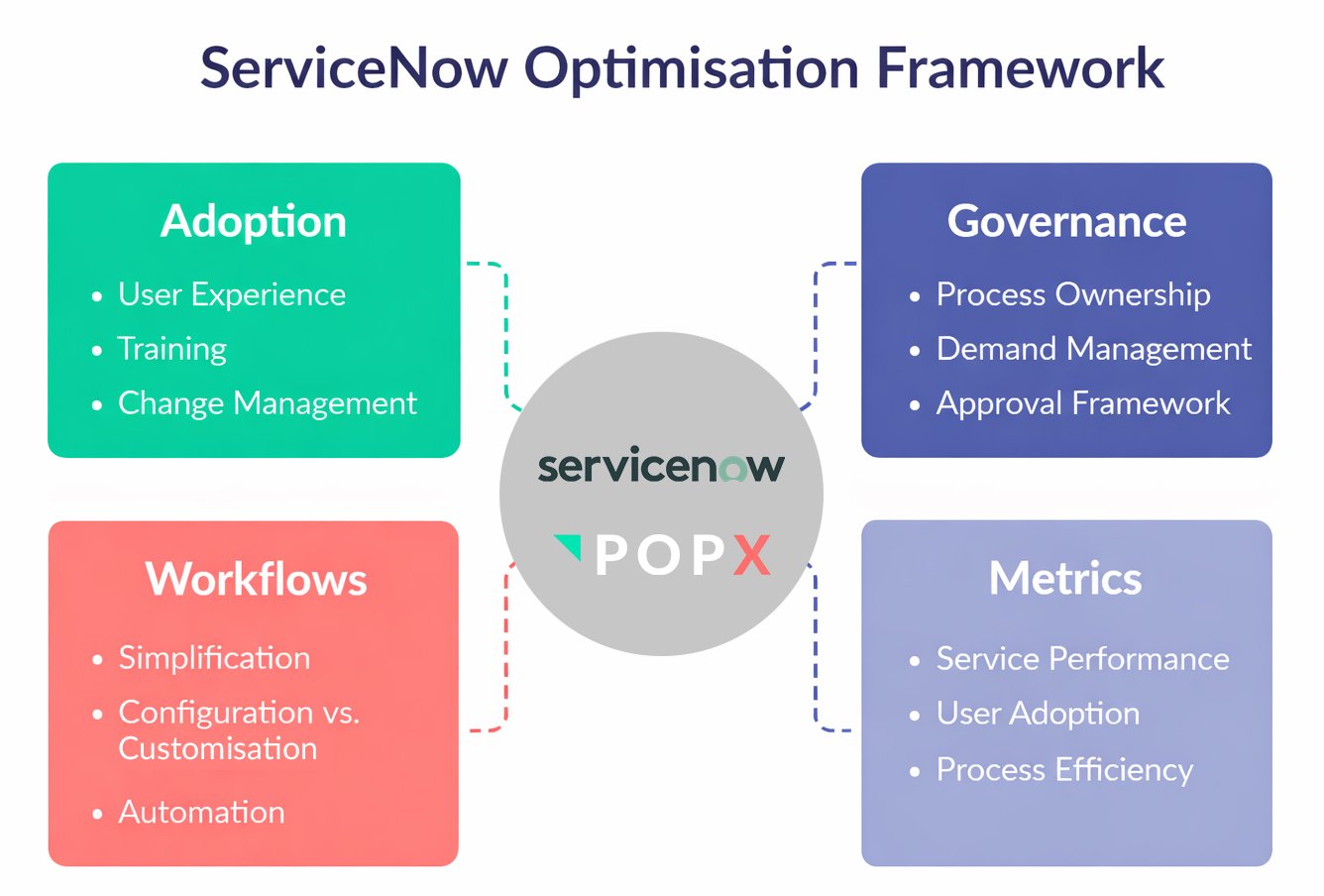
1. Design ServiceNow Around Real User Workflows
The most successful ServiceNow environments are designed around how people actually work, not simply around installed modules.
Start by:
- Interviewing users across teams
- Mapping real tasks and service journeys
- Removing unnecessary fields and approval steps
- Simplifying the portal experience
When workflows match real working patterns, ServiceNow becomes an intuitive platform that employees want to use rather than avoid.
2. Strengthen ServiceNow Governance
Without strong governance, ServiceNow environments quickly accumulate technical debt and unnecessary complexity.
Effective governance typically includes:
- Clear ownership of processes and workflows
- A prioritisation framework for new requests
- Approval processes for customisations
- Regular platform review cycles
Strong governance ensures the platform continues to deliver value rather than becoming increasingly difficult to manage.
3. Reduce ServiceNow Customisation
Many organisations customise ServiceNow heavily during the early stages of implementation. While customisation can solve short-term problems, excessive changes can make upgrades more difficult and increase long-term maintenance costs.
Adopting a configuration-first approach helps organisations:
- reduce technical complexity
- simplify upgrades
- maintain platform scalability
Often, simplifying the platform unlocks significant improvements in performance and usability.
4. Measure ServiceNow Success with the Right Metrics
Tracking the right metrics is essential for understanding whether ServiceNow is delivering value.
Instead of focusing on vanity metrics, organisations should measure:
- user adoption by role
- service request resolution times
- process completion rates
- rework and exception rates
- overall service performance
These indicators reveal whether ServiceNow is genuinely improving operational outcomes.
ServiceNow Transformation Case Study: How POPX Helped Node4
One example of successful ServiceNow optimisation comes from POPX’s work with Node4, a fast-growing managed services provider.
Following a series of acquisitions, Node4 found itself managing four separate service management systems, each with different processes and data standards. This fragmentation made ServiceNow harder to govern and prevented the platform from acting as a single source of truth.
POPX partnered with Node4 to transform their platform through the POPX Managed Service Platform powered by ServiceNow.
Together we:
- Consolidated multiple ITSM platforms into a single ServiceNow environment
- Standardised service management processes across teams
- Simplified workflows and improved data consistency
- Provided a managed platform to ensure continuous optimisation
The results were significant. Node4 achieved:
- a single central service platform replacing all legacy systems
- improved operational efficiency and cost savings
- better customer and employee experiences through streamlined workflows
- consistent governance across the organisation
- a scalable platform capable of supporting future growth
This example shows how aligning ServiceNow with real business processes can transform the platform from an operational bottleneck into a strategic enabler.
How to Make ServiceNow Deliver Long-Term Business Value
ServiceNow delivers the greatest value when organisations treat it as a continuous platform strategy rather than a one-time implementation.
Successful organisations focus on strong platform governance, ongoing optimisation, alignment with business processes, and consistent data and reporting standards.
By continually refining the platform, ServiceNow can become a powerful foundation for enterprise service management and operational efficiency.
Need Help Fixing Your ServiceNow Platform?
If your ServiceNow implementation isn’t delivering the value you expected, it may be time to reassess how the platform is designed and governed.
Many organisations discover their ServiceNow implementation isn’t working simply because the platform hasn’t been optimised for real-world workflows.
Our specialists can help you:
- improve ServiceNow adoption
- simplify workflows
- strengthen governance
- optimise platform performance
Get a ServiceNow Health Check
If your ServiceNow platform isn’t delivering the value you expected, POPX can help identify adoption gaps, governance issues, and optimisation opportunities.
ServiceNow Optimisation FAQs
-
Why do ServiceNow implementations fail?
ServiceNow implementations often fail because organisations prioritise installing features rather than designing workflows around real user needs. Poor governance, excessive customisation, and low adoption are common factors that prevent the platform from delivering its full value.
-
Can ServiceNow be fixed without re-implementing it?
Yes. Many ServiceNow challenges can be resolved through optimisation rather than full replacement. Improving governance, simplifying workflows, and increasing user adoption can dramatically improve platform performance.
-
What is a ServiceNow health check?
A ServiceNow health check is an assessment of how effectively a ServiceNow platform is configured, governed, and used. It typically reviews workflows, customisations, adoption levels, and reporting capabilities to identify optimisation opportunities.
-
How long does ServiceNow optimisation take?
The timeline depends on the complexity of the environment. Many organisations begin seeing improvements within weeks once governance, workflows, and adoption challenges are addressed.